
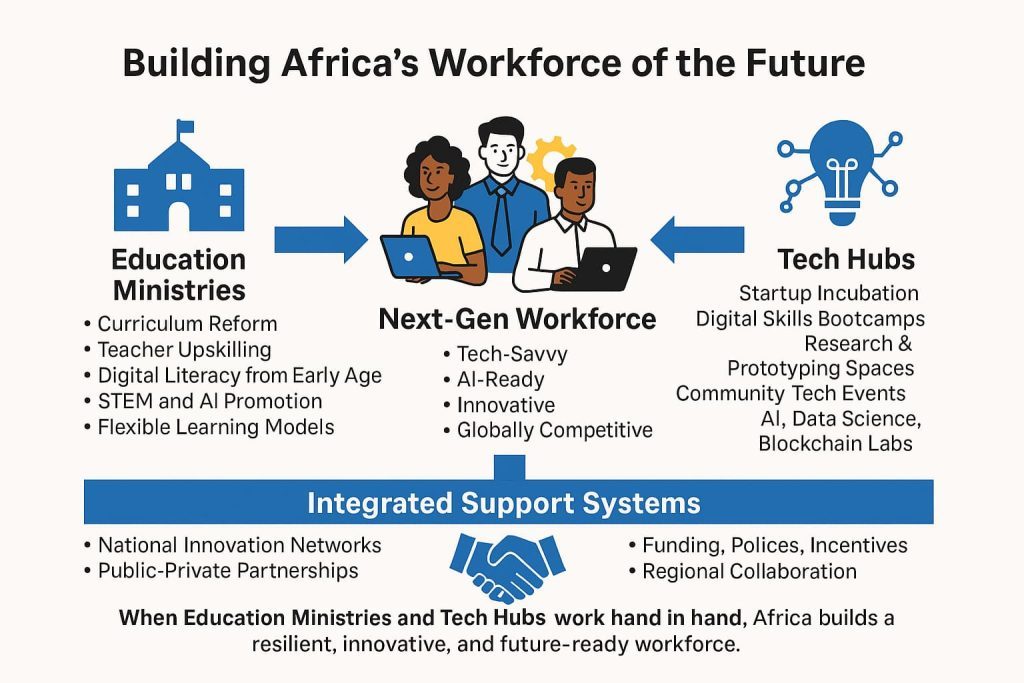
Without technological and AI capacity, Africa risks widening its economic, innovation, and social gaps with the rest of the world. The future of work is deeply tied to digital skills, automation, AI integration, and the ability to innovate rapidly. If African nations do not urgently build capacity in these areas, the workforce will likely be trapped in low-productivity, low-income sectors, unable to compete in global markets or drive internal transformation.
Key Risks:
Widening unemployment (especially among youth)
Brain drain (as talents migrate to where their tech skills are better nurtured and rewarded)
Marginalization in the global economy
Increased dependency on imported technology solutions
Exacerbated inequalities within societies
What Should Education Ministries and Academic Institutions Do to Prepare a Workforce of the Future?
- Revamp Curricula:
Integrate technology, AI, digital literacy, and critical thinking from primary through tertiary education.
Make coding, data analysis, robotics, and AI ethics standard subjects.
Emphasize problem-solving, creativity, entrepreneurship, and adaptability over rote memorization.
- Teacher Upskilling:
Launch massive national programs to retrain and equip teachers in emerging technologies.
Encourage partnerships with tech companies to train teachers at low or no cost.
- Flexible Learning Models:
Blend traditional classroom models with e-learning, virtual labs, and micro-credential programs (short specialized courses).
- STEM and Innovation Ecosystem:
Promote STEM education among girls and marginalized communities.
Fund innovation competitions, tech fairs, and youth incubators linked directly to schools.
- Industry-Education Alignment:
Work closely with private companies to ensure the skills taught match industry needs.
Encourage internships, apprenticeships, and live project-based learning from an early age.
How Can We Leverage Private and Public Tech Hubs to Catch Up with Global Trends?
- Policy and Funding Support:
Ministries should recognize tech hubs as strategic national assets and provide funding, tax incentives, and technical support.
Public-private co-financing of startup accelerators, AI labs, and maker spaces.
- Capacity Building Programs:
Partner with hubs to run bootcamps, reskilling programs, and certifications in AI, cloud computing, data science, cybersecurity, and blockchain.
- Create National Innovation Networks:
Connect all recognized tech hubs into a national network to share best practices, resources, and opportunities.
Encourage cross-border collaboration with tech hubs in other African countries (pan-African knowledge sharing).
- Use Hubs as Talent Bridges:
Integrate hubs into educational pipelines — students could spend a semester working at a tech hub instead of doing only traditional internships.
- Encourage Local Solutions:
Tech hubs should be incentivized to focus on local challenges using AI and emerging technologies (e.g., agriculture, healthcare, governance, education).
- National AI Strategies:
Ministries could develop a National AI Strategy that deliberately embeds hubs as incubators and accelerators for AI-driven startups and research.
Africa’s education ministries need to radically reform learning systems around technology, AI, and future skills while activating tech hubs as dynamic engines of training, innovation, and entrepreneurship. Without this dual approach, the continent risks being digitally colonized again — this time, not by guns, but by code.
Without urgent reforms in education and investment in tech hubs, Africa risks falling behind in the digital economy. Discover how curriculum reforms, teacher upskilling, and tech hubs can shape a future-ready workforce.